
Denavit-Hartenberg Parameters: The Foundation of Robot Kinematics Modeling
A practical engineering guide to DH parameters, coordinate frame assignment, and forward kinematics for industrial robots

Introduction
In robot kinematics modeling, the Denavit-Hartenberg (DH) parameter method stands as the most widely adopted standardized approach in industrial applications. Introduced by Jacques Denavit and Richard Hartenberg in 1955, this method remains the cornerstone of robot forward kinematics analysis nearly seven decades later.
The elegance of the DH method lies in its ability to completely describe the spatial relationship between adjacent links using just four parameters. This systematic approach transforms complex three-dimensional spatial transformations into standardized matrix operations, dramatically simplifying robot kinematics analysis.
The Essence of DH Parameters: Minimal Representation of Spatial Relationships
The core concept of the DH method involves establishing a fixed coordinate frame on each link and describing the spatial relationship between adjacent frames using four parameters:
Link Length a(i): The distance along the x(i) axis from the z(i) axis to the z(i+1) axis. This parameter represents the geometric dimensions of the link itself.
Link Twist α(i): The angle about the x(i) axis from the z(i) axis to the z(i+1) axis. This parameter describes the spatial angular relationship between adjacent joint axes.
Link Offset d(i): The distance along the z(i) axis from the x(i-1) axis to the x(i) axis. For revolute joints, this is a constant; for prismatic joints, this is the variable.
Joint Angle θ(i): The angle about the z(i) axis from the x(i-1) axis to the x(i) axis. For revolute joints, this is the variable; for prismatic joints, this is a constant.
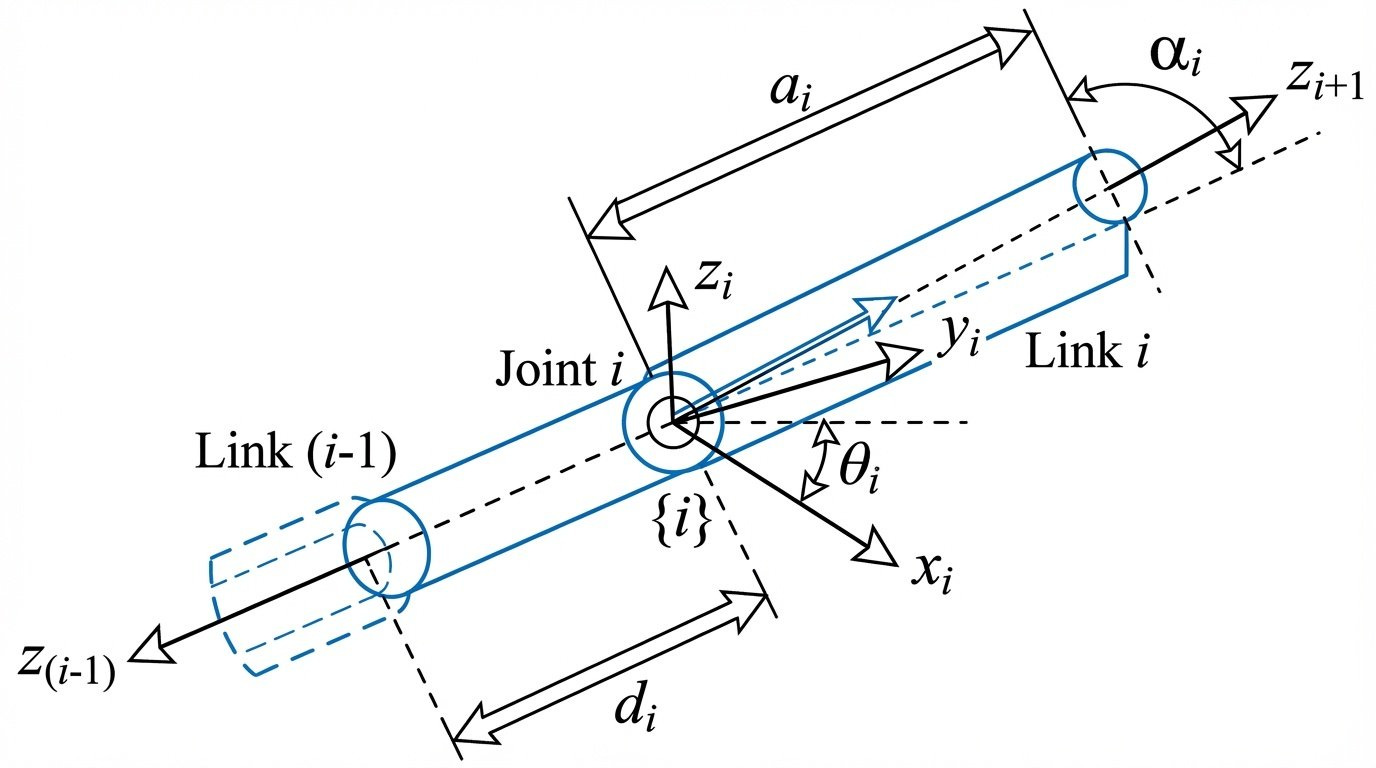
Among these four parameters, only one is variable for each joint, while the other three are constants determined by the robot’s mechanical structure. This clever parameterization enables the DH method to completely describe a robot’s kinematic characteristics with minimal parameters.
Coordinate Frame Establishment: Core Rules of the DH Method
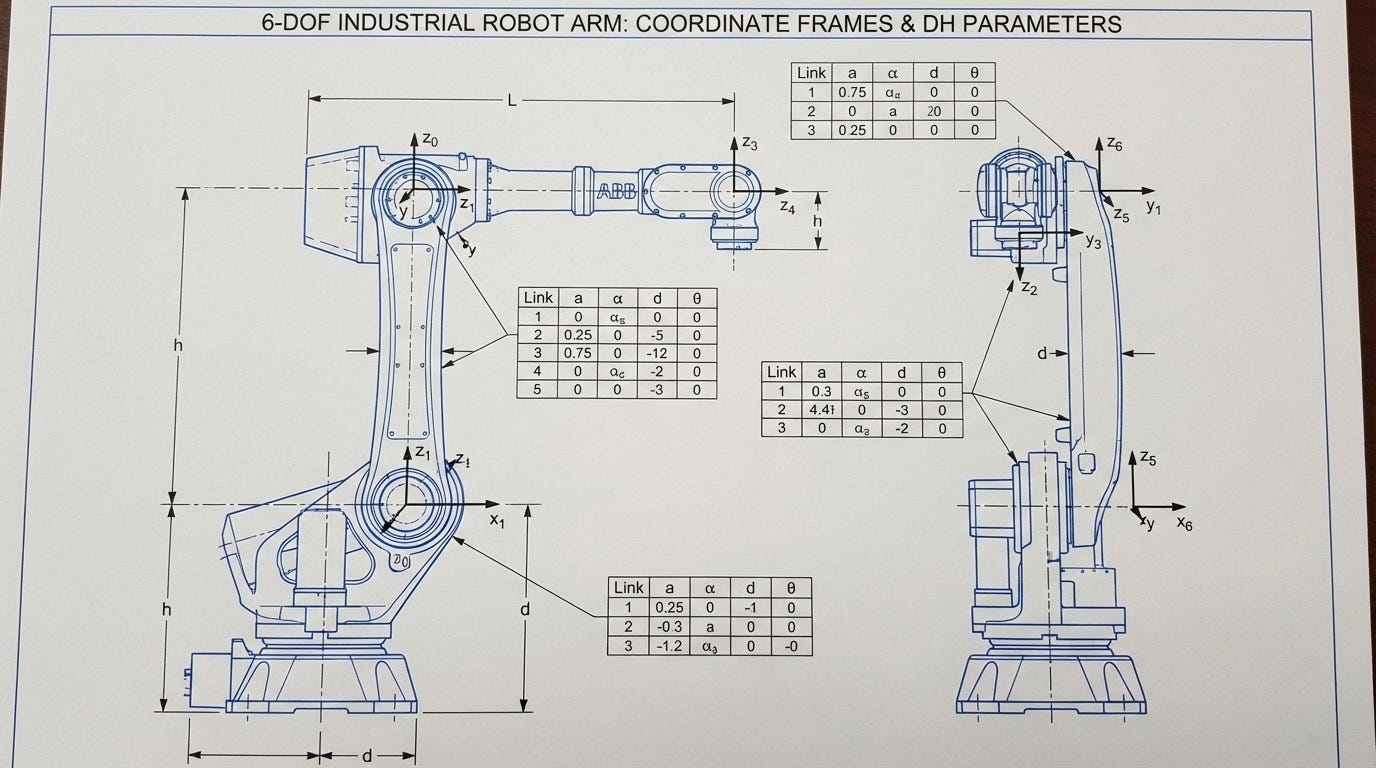
Correct coordinate frame establishment is crucial when applying the DH method. The standard DH convention follows these rules:
Z-axis Rule: The z(i) axis aligns with the axis of joint i+1. For revolute joints, the z-axis is the rotation axis; for prismatic joints, it’s the translation direction.
X-axis Rule: The x(i) axis follows the common normal between z(i) and z(i+1), pointing from z(i) toward z(i+1). When axes intersect, the x-axis is perpendicular to the plane containing both axes; when axes are parallel, the x-axis position is not unique—typically chosen to simplify parameters.
Y-axis Rule: The y-axis follows the right-hand rule, ensuring xyz forms a right-handed coordinate system.
Origin Location: The origin of frame {i} is located at the intersection of z(i) and x(i).
While these rules appear straightforward, practical application requires careful analysis of joint axis spatial relationships. The choice of x-axis direction particularly affects parameter simplicity when dealing with parallel or intersecting axes.
Standard vs Modified DH: Subtle Differences with Significant Impact
Throughout the development of the DH method, two primary parameter conventions emerged: Standard DH (Distal Convention) and Modified DH (Proximal Convention). The fundamental difference lies in coordinate frame attachment locations and transformation sequence.
Standard DH places the origin of frame {i} on the axis of joint i+1, with transformation sequence: Rotate θ(i) about z(i-1) → Translate d(i) along z(i-1) → Translate a(i) along x(i) → Rotate α(i) about x(i).
Modified DH places the origin of frame {i} on the axis of joint i, with transformation sequence: Translate a(i-1) along x(i-1) → Rotate α(i-1) about x(i-1) → Translate d(i) along z(i) → Rotate θ(i) about z(i).
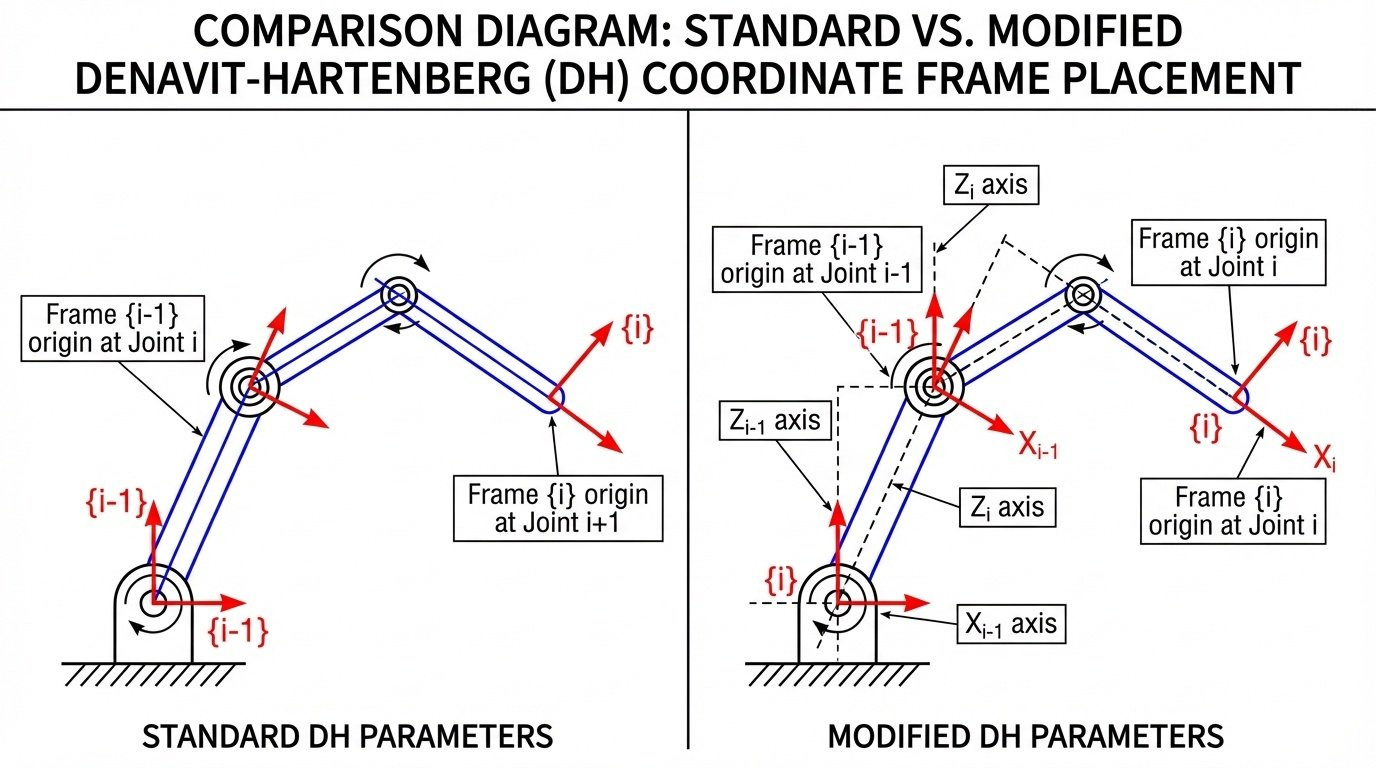
The advantage of Modified DH lies in the direct correspondence between frame {i} and joint i, which aligns better with engineering intuition in certain scenarios. Many commercial robot simulation tools, such as MATLAB Robotics Toolbox, employ Modified DH. However, Standard DH remains more prevalent in academic literature. Both methods are fundamentally equivalent—the key is maintaining consistency and avoiding mixing conventions.
DH Modeling Workflow: From Structural Analysis to Parameter Tables
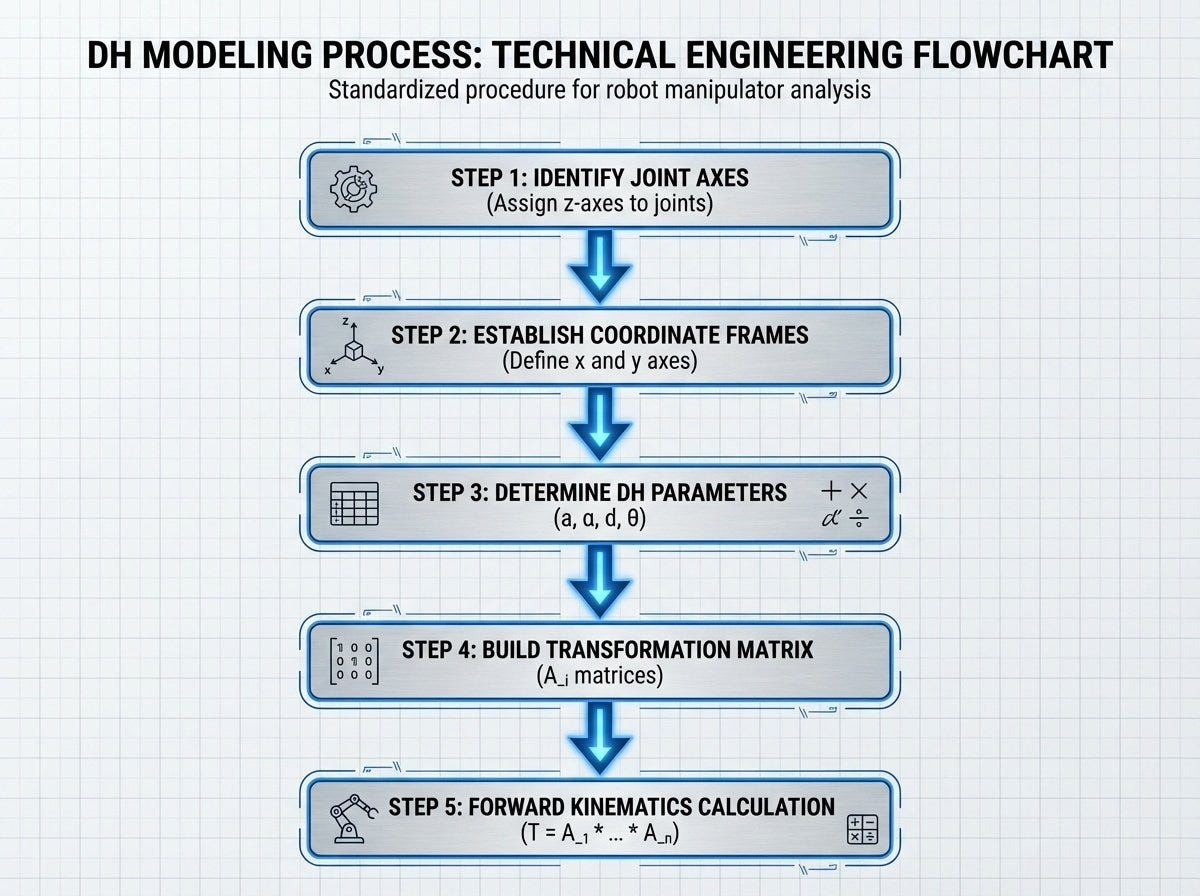
Establishing a robot’s DH model follows a systematic workflow:
Step 1: Identify Joint Axes. Carefully observe the robot’s mechanical structure to determine each joint’s motion axis. For complex mechanisms, CAD models or physical measurements may be necessary.
Step 2: Establish Coordinate Frames. Apply DH rules to establish coordinate frames on each link. Base frame {0} is typically set according to practical needs, while end-effector frame {n} is generally established at a feature point on the end-effector.
Step 3: Determine DH Parameters. Based on geometric relationships between adjacent frames, measure or calculate the four DH parameters. This step requires integration with actual structural dimensions.
Step 4: Build DH Parameter Table. Systematically organize all parameters in tabular form, clearly indicating which are constants and which are joint variables.
Step 5: Construct Transformation Matrices. Write homogeneous transformation matrices between adjacent frames based on DH parameters, then multiply them to obtain the total transformation matrix.
Forward Kinematics Solution: From Joint Space to Cartesian Space
After establishing the DH parameter table, forward kinematics solution reduces to matrix operations. The homogeneous transformation matrix between adjacent frames has a standard form:
T(i-1,i) = Rot(z, θ(i)) · Trans(z, d(i)) · Trans(x, a(i)) · Rot(x, α(i))
This expands to a 4×4 homogeneous transformation matrix. Multiplying all adjacent transformation matrices:
T(0,n) = T(0,1) · T(1,2) · T(2,3) · ... · T(n-1,n)
The resulting T(0,n) matrix contains position and orientation information for the end-effector relative to the base frame. The first three columns represent the three axis directions of the end-effector frame, while the fourth column represents the position of the end-effector origin.
This matrix-based solution approach is ideally suited for computer implementation and serves as the foundation for path planning and trajectory tracking in robot control systems.
Engineering Practice: Practical Considerations
In practical engineering applications, DH modeling requires attention to several aspects:
Structural Simplification: For complex robot mechanisms, appropriate simplification may be necessary. For example, ignoring minor assembly errors or treating approximately parallel axes as ideally parallel. Such simplifications are acceptable in most applications.
Singularity Handling: When two joint axes are parallel or coincident, x-axis selection is not unique. DH parameters may have multiple solutions—choose the configuration that yields the simplest parameter table. Special configurations (such as spherical wrists) require particular attention.
Zero Position Definition: Joint zero position definition directly affects θ(i) and d(i) values. In practice, zero positions should be defined at the robot’s standard posture or positions convenient for measurement.
Parameter Calibration: Manufacturing and assembly errors cause actual DH parameters to deviate from design values. High-precision applications require robot calibration techniques to correct these parameters, potentially improving absolute positioning accuracy by an order of magnitude.
Software Implementation: Modern robot systems typically use parameterized DH models. When changing robot models, only the DH parameter table needs modification—control algorithms can be reused. While ROS (Robot Operating System) URDF format doesn’t directly use DH parameters, the underlying kinematics solution principles remain consistent.
Limitations and Alternative Methods
Despite widespread application, the DH method has limitations:
Parameter Discontinuity: When mechanisms undergo minor changes (such as parallel axes becoming slightly skewed), DH parameters may change abruptly. This poses challenges in robot optimization design.
Singularities: Under certain special configurations, DH parameters may not be unique or may not exist, requiring special handling.
Representational Redundancy: For some simple mechanisms, the DH method may introduce unnecessary parameters.
In recent years, the Product of Exponentials (POE) method based on screw theory has gained attention. The POE method uses screw representations of joint axes, avoiding some limitations of the DH method and demonstrating advantages in robot dynamics modeling and trajectory optimization. However, the DH method remains the mainstream choice for industrial applications due to its intuitiveness and mature toolchain support.
Conclusion
The DH parameter method, as a classical approach to robot kinematics modeling, has developed a complete theoretical framework and engineering practice standards over nearly 70 years. Mastering the DH method is not only fundamental to understanding robot kinematics but also an essential skill for robot system development, simulation, and control.
In practical applications, the choice between Standard DH or Modified DH should be based on specific robot structures and application requirements, with attention to coordinate frame establishment standards and parameter measurement accuracy. While new modeling methods have emerged with robot technology development, the DH method will maintain its core position for considerable time due to its systematic nature and practicality.
References
Denavit, J., & Hartenberg, R. S. (1955). “A kinematic notation for lower-pair mechanisms based on matrices.” Journal of Applied Mechanics, 22(2), 215-221.
Craig, J. J. (2005). Introduction to Robotics: Mechanics and Control (3rd ed.). Pearson Education.
Spong, M. W., Hutchinson, S., & Vidyasagar, M. (2006). Robot Modeling and Control. John Wiley & Sons.
🎯 Master Robotics Engineering (The Way School Never Taught)
After 13 years in the field, I’ve learned that the best engineering knowledge doesn’t come from textbooks—it comes from real projects, failures, and breakthroughs.
That’s what I share every week in The Robotics Engineer’s Digest:
Technical Deep Dives → Real engineering analysis with formulas
Case Study Breakdowns → Learn from $100K+ mistakes (so you don’t repeat them)
Component Selection Guides → Decision frameworks for motors, reducers, sensors
Industry Intelligence → What’s actually happening in humanoid robotics, automation, AI
100% free. Zero spam. Unsubscribe anytime.
💬 What Are You Working On Right Now?
I create content based on what engineers actually need.
Comment below and tell me:
What type of robot/automation project are you working on?
What’s your biggest technical challenge right now?
What topic would you like me to cover next?
100+ engineers have already shared. Your input shapes future articles!
Join 100+ robotics engineers getting smarter every week: