
Newton-Euler vs Lagrange Methods in Robot Dynamics: A Technical Deep Dive
Understanding the theory, computation, and engineering applications of two fundamental approaches to robotic system modeling

In the field of robotic system design and control, dynamic modeling remains fundamental to achieving precise motion planning and high-performance control. From six-axis manipulators on industrial assembly lines to mobile robots in warehouse logistics, and bipedal walking robots in frontier research, accurate dynamic models directly determine system performance. Among the various modeling approaches, the Newton-Euler method and Lagrange method stand out as two classical and widely applied techniques for dynamic analysis, each with distinct characteristics and complementary strengths. A thorough understanding of these methods’ theoretical foundations, computational properties, and engineering application scenarios holds significant practical value for robotic system development and optimization.
The Engineering Significance of Dynamic Modeling
The core challenge in robot dynamics lies in establishing mathematical relationships between a system’s motion state (position, velocity, acceleration) and the forces/torques acting upon it. This relationship can be described through two fundamental problems: forward dynamics and inverse dynamics. Forward dynamics addresses the problem of determining system motion given applied forces, commonly used in simulation verification and trajectory optimization. Inverse dynamics solves for the required driving forces given a desired trajectory, extensively applied in feedforward controller design.
The accuracy of dynamic modeling directly impacts multiple key performance metrics in robotic systems. In trajectory tracking control, accurate dynamic models can significantly enhance control system response speed and tracking precision. For energy optimization, trajectory planning based on precise dynamic models effectively reduces energy consumption, particularly important in mobile robot and collaborative robot applications. Furthermore, in fault diagnosis and collision detection, comparing model predictions with actual measurements enables timely identification of system anomalies.
In practical projects, dynamic model selection requires comprehensive consideration of system complexity, real-time requirements, and computational resource constraints. For fixed-base industrial robots, standard rigid body dynamics assumptions typically suffice. For floating-base mobile robots or legged robots, the influence of base motion on overall dynamics must be considered, often requiring more complex full-dynamics modeling approaches.
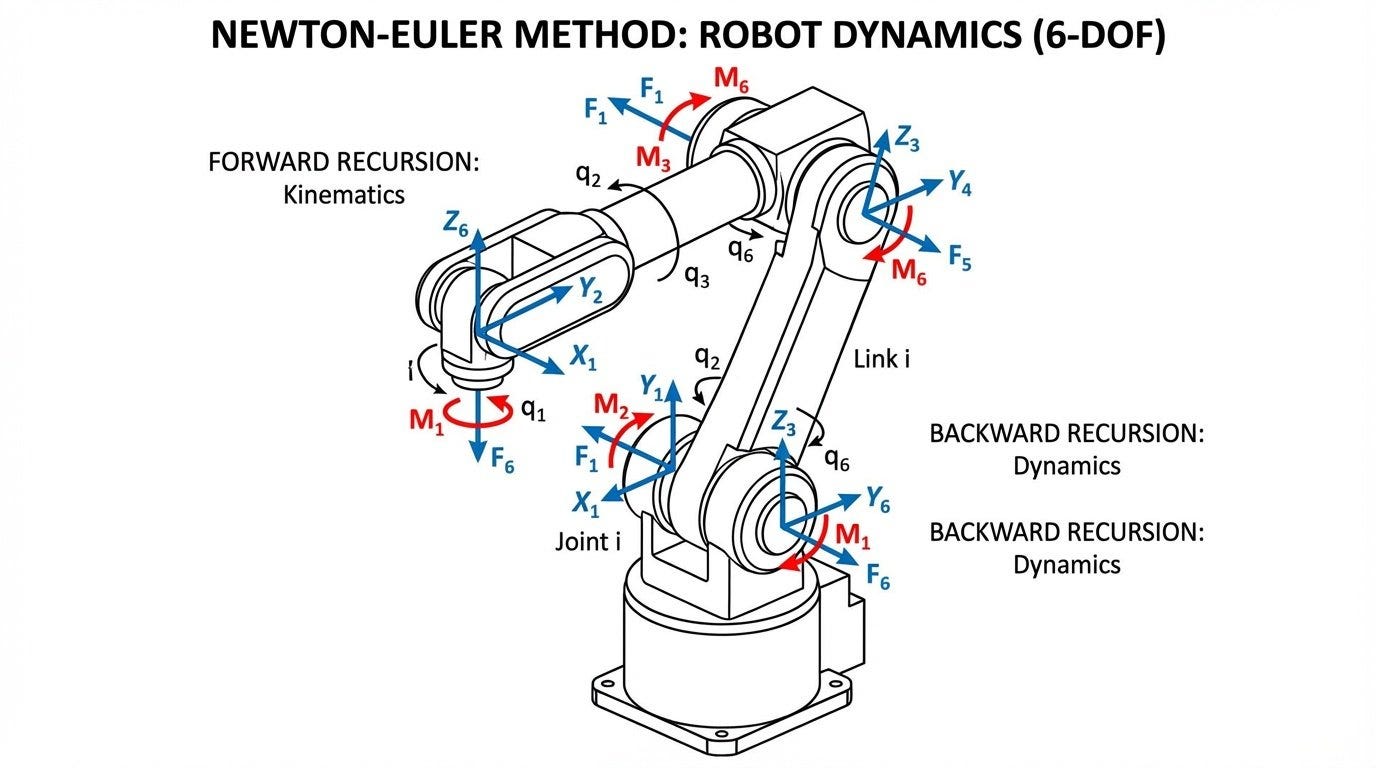
Newton-Euler Method: From Force Balance to Recursive Algorithms
Theoretical Foundation and Mathematical Formulation
The theoretical foundation of the Newton-Euler method derives from Newton’s second law and Euler’s equations in classical mechanics. For each link in a robotic system, its dynamic behavior can be completely described by the external forces and moments acting upon it. Specifically, Newton’s second law describes the link’s linear motion, while Euler’s equations describe its rotational motion.
The core concept of this approach involves decomposing a complex multi-body system into individual rigid bodies, then applying Newton-Euler equations to each. For link j in a robotic system, the Newton-Euler equations state that the total external force acting on link j equals the time derivative of its linear momentum, while the total external moment equals the time derivative of its angular momentum.
This formulation’s advantage lies in its clear physical meaning—each equation corresponds to force balance or moment balance. In practical calculations, fundamental inertial parameters including link mass, center of mass position, and inertia tensor must be considered.
Recursive Newton-Euler Algorithm
The true power of the Newton-Euler method manifests in its recursive algorithm implementation. The Recursive Newton-Euler Algorithm (RNEA), proposed by Luh, Walker, and Paul in 1980, completes the entire system’s dynamic calculations through two recursive passes. This algorithm structure is not only elegant and concise but also extremely computationally efficient, making it one of the most commonly used dynamic calculation methods in current engineering applications.
The algorithm’s first stage is forward recursion, computing kinematic parameters for each link sequentially from the base to the end-effector. This process calculates angular velocities, angular accelerations, linear accelerations, and total external forces and moments acting on each link. Notably, by initializing linear acceleration as the negative of gravitational acceleration, gravity effects are automatically incorporated into the dynamic equations—an ingenious engineering technique.
The second stage is backward recursion, computing interaction forces between links from the end-effector back to the base. Through backward propagation, this process calculates required joint driving torques while considering motor inertia and friction effects. This bidirectional recursive structure yields computational complexity of only O(n), where n is the number of joints, providing significant computational advantages over traditional symbolic derivation methods.
Extensions for Complex Structures
While the basic recursive Newton-Euler algorithm targets serial robots, its framework extends to more complex robotic structures. For tree-structured robots, the algorithm handles branching connections by defining predecessor functions. For closed-loop mechanisms, virtual joint cuts and constraint equations transform them into equivalent tree structures.
For parallel robots, the system is typically decomposed into a platform and several legs, with each leg’s dynamics calculated separately in Cartesian space, then projected to joint space via Jacobian matrices and finally aggregated into overall dynamic equations. For robots with flexible joints, elastic deformation parameters must be introduced, and recursive formulas modified to account for joint flexibility effects.
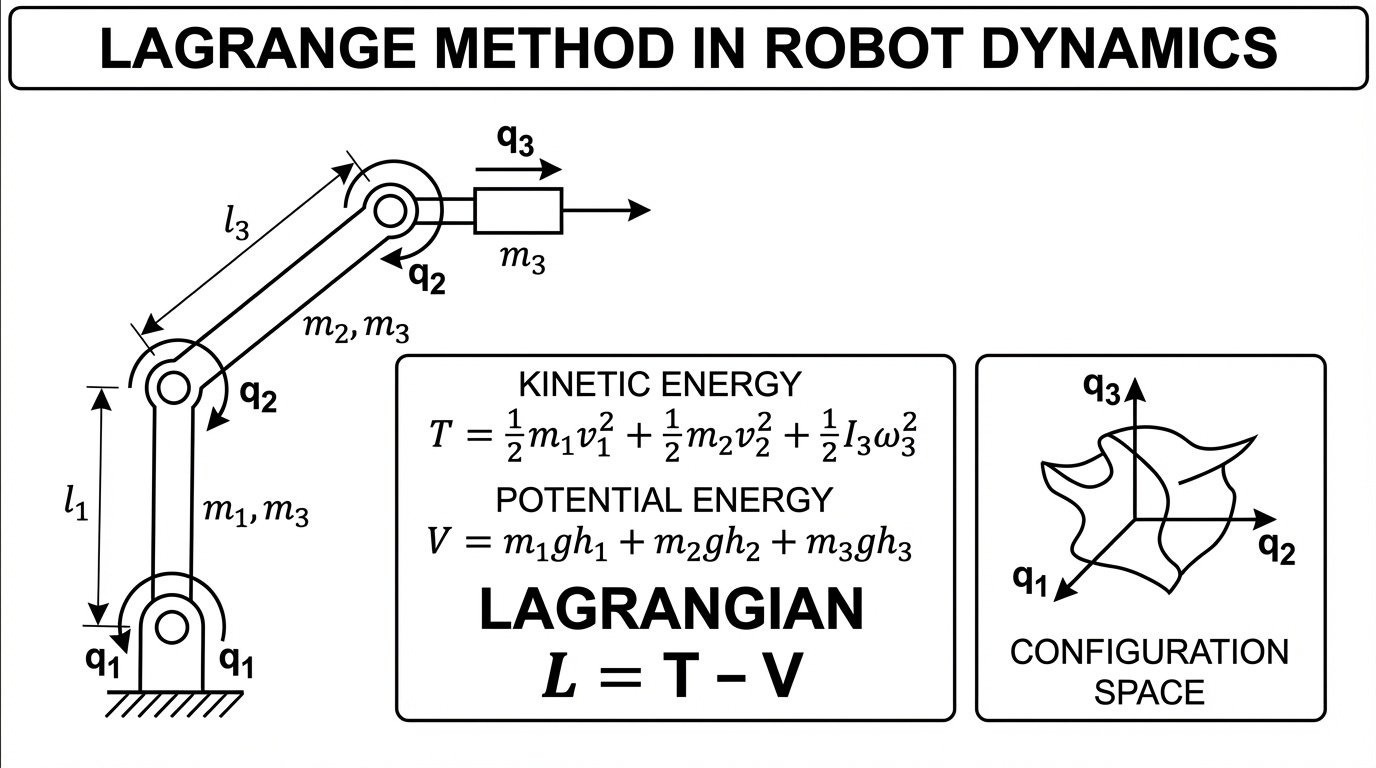
Lagrange Method: System Dynamics from an Energy Perspective
Fundamental Principles of Lagrangian Mechanics
The Lagrange method builds upon analytical mechanics’ energy principles, describing dynamic behavior through system kinetic and potential energy. The Lagrangian function is defined as the difference between kinetic and potential energy: L = T - U, where T represents total kinetic energy and U represents total potential energy. This energy-based description offers unique advantages: it uses scalar functions rather than vector equations, naturally accommodates generalized coordinate systems, and systematically handles constraint conditions.
The standard form of Lagrange’s equation states: for each generalized coordinate qi, the dynamic equation can be expressed as d/dt(∂L/∂q̇i) - ∂L/∂qi = τi, where τi is the corresponding generalized force. This equation’s physical significance: system motion along any generalized coordinate direction is jointly determined by the energy gradient in that direction and the generalized force. Compared to the Newton-Euler method requiring force balance consideration for each link, the Lagrange method only requires calculating total system energy, particularly convenient when handling complex constraints.
Lagrangian Modeling of Robotic Systems
Applying the Lagrange method to robotic systems first requires calculating total system kinetic energy. For a robot composed of n links, total kinetic energy includes translational and rotational kinetic energy for each link, expressible as a quadratic function of joint velocities. The potential energy component primarily considers gravitational potential energy, which can be neglected for robots moving in horizontal planes but must be considered for manipulators moving in vertical planes.
Substituting kinetic and potential energy into Lagrange’s equation yields the standard form of manipulator equations: M(q)q̈ + C(q,q̇)q̇ + G(q) = τ, where M(q) is the mass matrix, C(q,q̇) represents Coriolis and centrifugal force terms, and G(q) is the gravity term. This standard form is widely used in robotics because it clearly reveals the structural properties of system dynamics. Particularly noteworthy: the mass matrix M(q) is always positive definite and symmetric, a property of significant importance in controller design.
Constraint Handling and Nonholonomic Systems
The Lagrange method demonstrates unique advantages when handling constrained systems. For mobile robots with nonholonomic constraints, such as pure rolling constraints in wheeled robots, Lagrange multipliers can systematically address these constraints. Nonholonomic constraints refer to constraint conditions involving only velocities that cannot be integrated into position constraints, very common in wheeled mobile platforms.
In actual modeling processes, introducing Lagrange multipliers yields complete dynamic equations including constraint forces, which can then be mathematically processed to eliminate the multipliers and obtain simplified dynamic models. This method’s systematic and standardized nature makes the modeling process clearer and reduces error potential. For closed-loop mechanisms, position constraint equations h(q)=0 can be defined, velocity and acceleration constraints obtained through differentiation, then constraint force terms HT(q)λ added to dynamic equations.
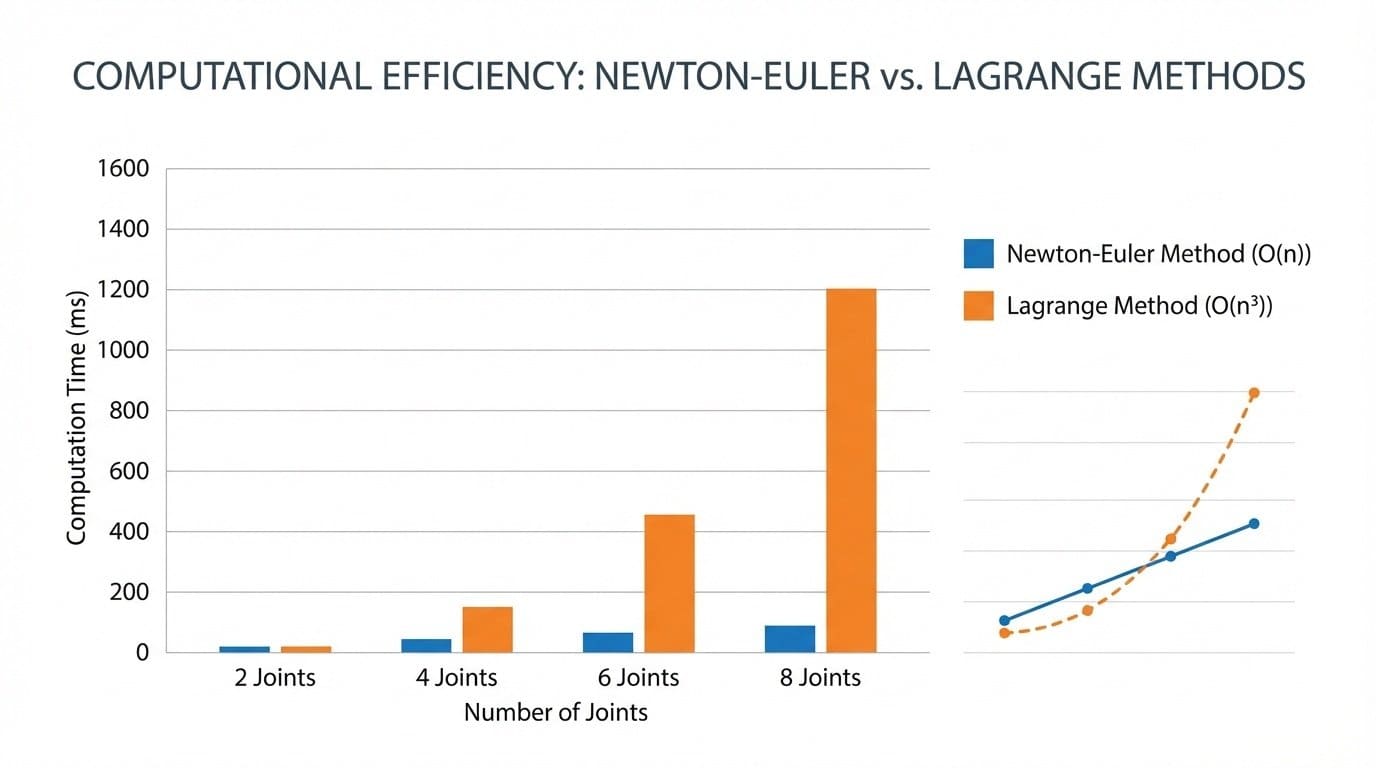
Systematic Comparative Analysis of Both Methods
Differences in Theoretical Frameworks
Though both the Newton-Euler and Lagrange methods accurately describe robotic system dynamic behavior, they are based on different theoretical frameworks, exhibiting distinct characteristics. The Newton-Euler method is based on vector mechanics, directly handling forces and moments acting on the system. The Lagrange method is based on scalar energy functions, indirectly obtaining dynamic equations through energy principles.
From a physical insight perspective, the Lagrange method provides superior systematic understanding, particularly for nonholonomic systems, as it directly relates forces to system energy. Conversely, the Newton-Euler method may face difficulties in quantifying interaction forces, especially in complex multi-body systems. However, the Newton-Euler method’s advantage lies in its more intuitive computational process, where each calculation step corresponds to clear physical meaning.
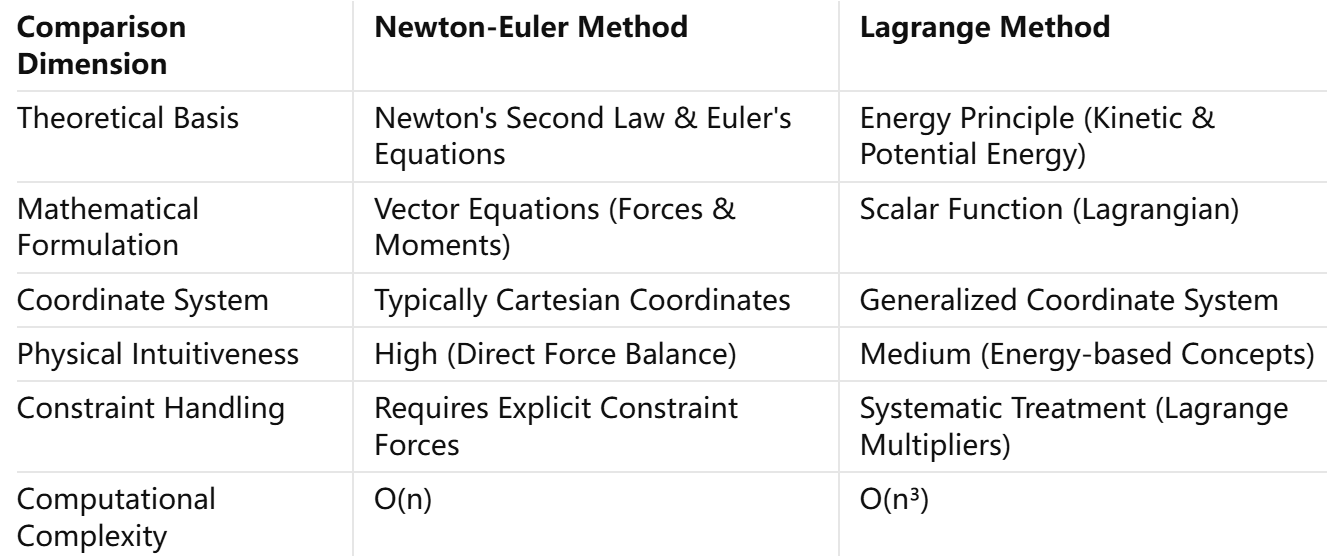
Quantitative Analysis of Computational Efficiency
Computational efficiency is a key consideration when selecting dynamic modeling methods, particularly in real-time control applications. The recursive Newton-Euler algorithm is considered one of the most efficient inverse dynamics algorithms currently available, with computational complexity of O(n), meaning computation time increases linearly with joint count. This linear complexity provides significant advantages when handling high-degree-of-freedom robots.
In contrast, traditional Lagrange methods establish dynamic equations through symbolic derivation, with computational complexity typically O(n³) or higher, primarily due to the need to calculate and manipulate numerous partial derivatives and matrix operations. However, it’s important to note that this complexity mainly manifests in the symbolic derivation stage; once explicit dynamic equations are established, subsequent numerical calculations can achieve high efficiency through code optimization.
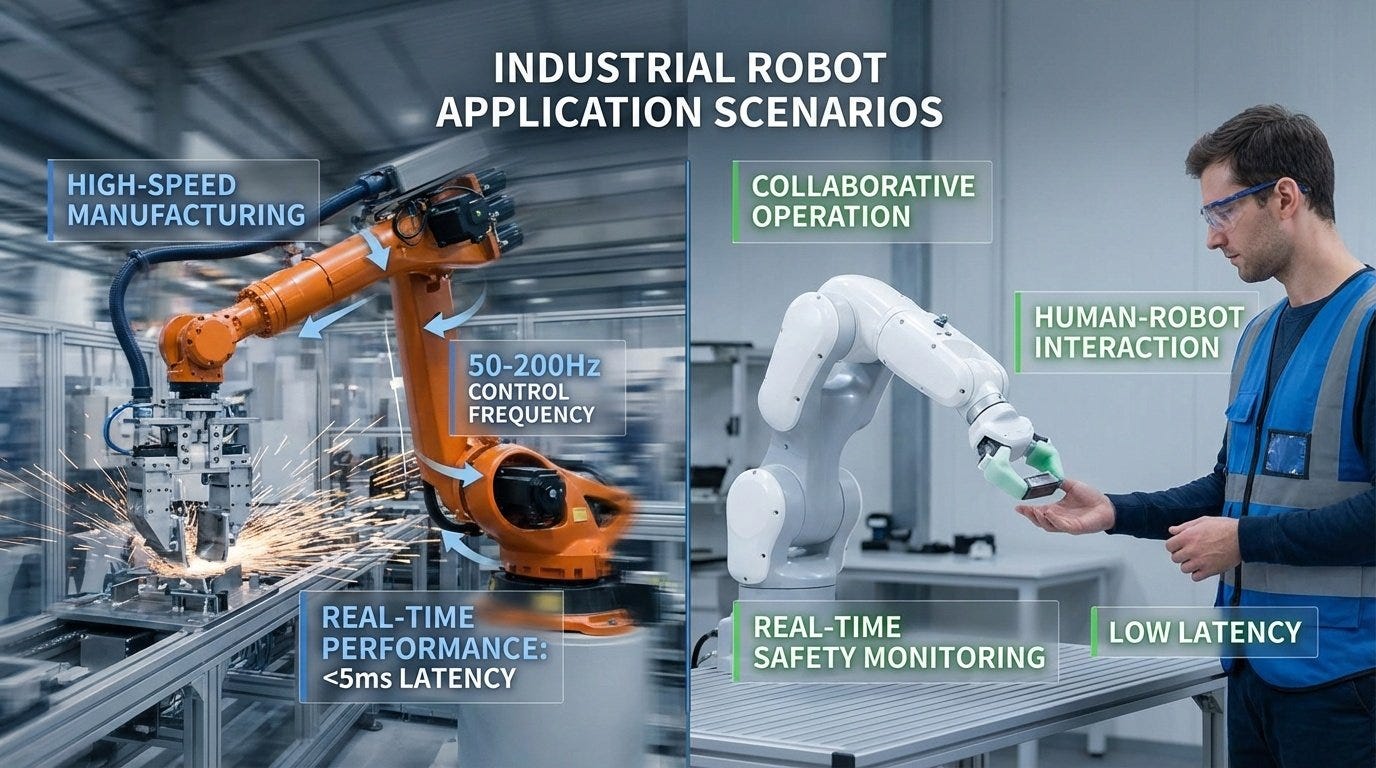
In real-time control applications, typical control frequencies range from 50Hz to 200Hz, meaning dynamic calculations must complete within 5 to 20 milliseconds. For complex robotic systems such as bipedal walking robots or dexterous manipulation systems, full-dynamics model predictive control requires solving optimization problems containing thousands of variables in extremely short times, placing extremely high demands on algorithm efficiency.
Application Scenarios and Engineering Selection
In practical engineering applications, selecting a modeling method requires comprehensive consideration of multiple factors. For serial-structure industrial robots, particularly in real-time control applications, the recursive Newton-Euler algorithm is typically the preferred choice due to its high computational efficiency and ease of implementation in embedded systems. Many commercial robot controllers have built-in dynamic calculation modules based on the Newton-Euler method.
For structurally simpler robots, such as two or three degree-of-freedom manipulators, the Lagrange method is often used in teaching and theoretical research due to its systematic nature and clear derivation process. Additionally, in scenarios requiring deep understanding of system energy characteristics, such as energy optimization or passive dynamics analysis, the Lagrange method provides more direct physical insights.
For robots with closed-loop structures or complex constraints, the Lagrange method has systematic advantages in handling constraint conditions. Through Lagrange multipliers, constraints can be introduced systematically, whereas the Newton-Euler method requires virtual cutting and projection techniques. In mobile robotics, nonholonomic constraint handling makes the Lagrange method a common choice.
Practical Applications in Industrial Robots and Advanced Control
Dynamic Control of Industrial Robots
In modern industrial robot systems, control strategies based on accurate dynamic models have become key technologies for enhancing system performance. On classic industrial robot platforms such as PUMA 560, researchers have validated multiple control strategies based on inverse dynamics, including computed torque control and adaptive control. The core concept of these control methods is utilizing dynamic models for feedforward compensation, thereby significantly improving system tracking accuracy and dynamic response.
Computed torque control represents a typical application of dynamic control. This method uses inverse dynamic models to calculate required joint torques in real-time to achieve desired trajectories, combined with PD feedback control to compensate for modeling errors and external disturbances. The key to this control strategy is that dynamic calculations must be sufficiently fast to meet real-time control requirements—precisely the application scenario for recursive Newton-Euler algorithms.
In high-speed pick-and-place applications, dynamic effects are particularly significant. Using only simple PID control while ignoring dynamic compensation results in obvious tracking errors and oscillations during high-speed motion. Introducing feedforward control based on dynamic models can significantly reduce tracking errors and improve production cycle times, critically important in automotive manufacturing, electronics assembly, and other fields requiring high precision and speed.
Safety and Compliant Control in Collaborative Robots
Collaborative robots (cobots), a rapidly developing robot type in recent years, have safety requirements that give dynamic modeling new roles. Through modified Newton-Euler methods, external collision forces and joint friction can be estimated online, enabling collision detection without external force sensors. This model-based collision detection method is low-cost and highly reliable, representing one of the key technologies for achieving safe human-robot collaboration.
Compliant control is another important function in collaborative robots. Through dynamic models, virtual impedance control can be implemented, making robots exhibit desired mechanical characteristics. This control strategy requires accurate dynamic models to achieve desired force feedback behavior, ensuring robots can safely respond to external forces when contacting humans or environments. In assembly, polishing, and other tasks requiring force control, this capability is crucial.
Dynamic Challenges in Mobile and Legged Robots
Mobile robots, particularly legged robots, present new challenges for dynamic modeling. For differential drive mobile robots, handling nonholonomic constraints is key to modeling, with both methods requiring careful treatment of pure rolling constraints. In practical applications, wheel-ground contact characteristics, ground irregularities, and other factors must also be considered, making high-fidelity model establishment more complex.
Legged robot dynamic modeling is even more complex. Whole-body model predictive control has been successfully deployed on quadruped and bipedal robots, achieving complex motion behaviors such as jumping, turning, and stair climbing. This control method requires solving optimization problems containing complete dynamic constraints in extremely short times, placing extremely high demands on algorithm efficiency. To this end, researchers have developed structure-exploiting algorithms that fully utilize the sparsity and recursive nature of robot dynamic equations to accelerate computation.
For contact dynamics handling, bilateral constraints typically must be represented as differential algebraic equations, then transformed into ordinary differential equation form through index reduction methods. Baumgarte stabilization methods are commonly used to prevent constraint drift during numerical integration. These technical details are crucial for implementing stable and reliable legged robot simulation and control.
Algorithm Optimization and Cutting-Edge Research Progress
Hybrid Optimization of Symbolic and Numerical Methods
Traditional dynamic modeling methods often face trade-offs between “symbolic complexity” and “numerical efficiency.” In recent years, researchers have developed various hybrid methods to balance these aspects. Through automatic differentiation techniques, accurate symbolic derivations can be maintained while achieving efficient numerical computation. This approach demonstrates significant advantages in complex optimization and control problems.
The development of open-source software frameworks has greatly promoted the popularization of dynamic modeling technologies. The Pinocchio library, as a high-performance rigid body dynamics library, implements fast dynamic calculations based on recursive Newton-Euler algorithms and provides automatic differentiation interfaces. Similar tools such as Drake, RBDyn, and RBDL provide researchers with validated efficient implementations, avoiding the difficulty of writing complex algorithms from scratch.
Discrete-Time Dynamic Modeling
Traditional dynamic models are typically established in continuous time domains, but discrete-time representations are needed in actual digital control systems. Recent research has proposed methods for establishing dynamic models directly in discrete-time domains with fixed time steps, which can significantly reduce simulation computational costs, achieving simulation speeds orders of magnitude faster than real-time.
The advantage of discrete-time modeling lies in its ability to directly match digital controller sampling periods, avoiding errors that may be introduced in continuous-to-discrete conversions. Additionally, when handling nonlinear phenomena such as friction, discrete-time models can provide more stable predictions, accurately predicting actual physical phenomena such as wheel locking and steady-state velocities. This holds significant importance for high-fidelity simulation and model-based controller design.
Machine Learning and Data-Driven Methods
In recent years, machine learning technologies have begun combining with traditional dynamic modeling methods, producing new research directions. Methods such as Lagrangian Neural Networks and Newtonian Neural Networks attempt to embed physical prior knowledge into neural network structures. These methods’ core idea is utilizing neural networks to learn system energy functions or mechanical equations while maintaining physical law constraints.
However, these data-driven methods also face challenges. Research shows that when joint torques are estimated through motor models rather than directly measured, Lagrangian network performance significantly decreases, suggesting that sensor configuration and measurement noise impacts must be carefully considered in practical applications. Nevertheless, these methods show potential in handling model uncertainties and adaptive learning, particularly in soft robots and underactuated systems difficult to model precisely.
Selection Strategies and Implementation Recommendations in Engineering Practice
Decision Process for Modeling Method Selection
Selecting appropriate dynamic modeling methods in actual projects requires systematic consideration of multiple factors. First is robot structure type: for serial-structure fixed-base robots, recursive Newton-Euler algorithms are typically the best choice; for parallel robots with closed-loop structures or mobile platforms with floating bases, the Lagrange method may have advantages in handling constraints.
Second is real-time requirements: if control frequency requirements exceed 100Hz, computational efficiency becomes a key factor, where the Newton-Euler method’s O(n) complexity advantage becomes apparent. System degree-of-freedom count is also an important consideration. For robots with fewer degrees of freedom, symbolic derivation using the Lagrange method is feasible, while for high-degree-of-freedom systems, recursive numerical algorithms are more practical.
Software Tools and Implementation Recommendations
When actually implementing dynamic models, fully utilizing mature open-source software libraries can greatly improve development efficiency and code quality. For C++ development environments, Pinocchio, RBDL, and Drake all provide high-performance dynamic calculation capabilities. For Python environments, PyBullet and MuJoCo provide easy-to-use interfaces and powerful simulation capabilities.
When selecting software tools, compatibility with existing systems, community support levels, and license types must be considered. For commercial product development, particular attention must be paid to open-source software license requirements. Additionally, fully utilizing advanced features provided by software libraries such as automatic differentiation and parallel computing can further enhance system performance.
Model Verification and Parameter Identification
Regardless of which modeling method is adopted, model verification and parameter identification are key steps in ensuring model accuracy. Actual robotic system inertial parameters, friction characteristics, etc., often deviate from theoretical design values and require identification through experimental data. Common parameter identification methods include least squares, recursive least squares, and optimization-based approaches.
In the model verification stage, model accuracy can be evaluated by comparing model-predicted joint torques with actual measured values. For robots equipped with external force sensors, end-effector contact force prediction accuracy can also be verified. Establishing comprehensive model verification procedures not only helps improve model quality but also provides a reliable foundation for subsequent controller debugging.
Conclusion and Future Outlook
The Newton-Euler and Lagrange methods, as two classical approaches to robot dynamics modeling, each possess distinct characteristics and complement each other. The Newton-Euler method dominates real-time control applications with its efficient recursive algorithms and O(n) computational complexity. The Lagrange method demonstrates advantages in theoretical analysis and complex constrained systems with its systematic constraint handling capabilities and clear energy perspective.
As robotic technology advances toward higher performance and stronger intelligence, dynamic modeling methods continue to evolve. The emergence of new technologies such as automatic differentiation, symbolic-numerical hybrid methods, and discrete-time modeling is breaking through traditional method limitations. The combination of machine learning and physical modeling opens new paths for handling model uncertainties and adaptive learning.
In engineering practice, deeply understanding both methods’ theoretical foundations, computational characteristics, and applicable scenarios, making reasonable selections based on specific project requirements, and fully utilizing mature software tools and verification methods are keys to successfully implementing high-performance robotic systems. As computational capabilities improve and algorithms optimize, dynamic models will play increasingly important roles in robot control.
🎯 Master Robotics Engineering (The Way School Never Taught)
After 13 years in the field, I’ve learned that the best engineering knowledge doesn’t come from textbooks—it comes from real projects, failures, and breakthroughs.
That’s what I share every week in The Robotics Engineer’s Digest:
Technical Deep Dives → Real engineering analysis with formulas
Case Study Breakdowns → Learn from $100K+ mistakes (so you don’t repeat them)
Component Selection Guides → Decision frameworks for motors, reducers, sensors
Industry Intelligence → What’s actually happening in humanoid robotics, automation, AI
100% free. Zero spam. Unsubscribe anytime.
💬 What Are You Working On Right Now?
I create content based on what engineers actually need.
Comment below and tell me:
What type of robot/automation project are you working on?
What’s your biggest technical challenge right now?
What topic would you like me to cover next?
100+ engineers have already shared. Your input shapes future articles!
Join 100+ robotics engineers getting smarter every week: