
The Technical Gap in Chinese Robot Reducers: Why Harmonic Drives Succeeded While RV Reducers Lag Behind
A deep dive into the manufacturing complexity, material science barriers, and systemic challenges that separate Chinese and Japanese precision transmission technology

Among the core components of industrial robots, reducers play a pivotal role in determining precision, load capacity, and operational lifespan. An intriguing phenomenon has emerged in China’s robotics industry: domestic harmonic drive reducers have reached competitive parity with international products, while RV reducers remain constrained by foreign suppliers. Understanding this technical disparity reveals fundamental insights into precision manufacturing and industrial development.
The Fundamental Technical Divergence
Harmonic Drives: Elegant Simplicity in Flexible Transmission
Harmonic drive technology operates on the principle of controlled elastic deformation. The mechanism comprises three essential components: a wave generator (elliptical cam), a flexspline (flexible gear ring), and a circular spline (rigid outer ring). The wave generator induces controlled elastic deformation in the flexspline, creating a unique “flex-to-mesh” transmission that achieves high reduction ratios, zero backlash, and compact form factors.
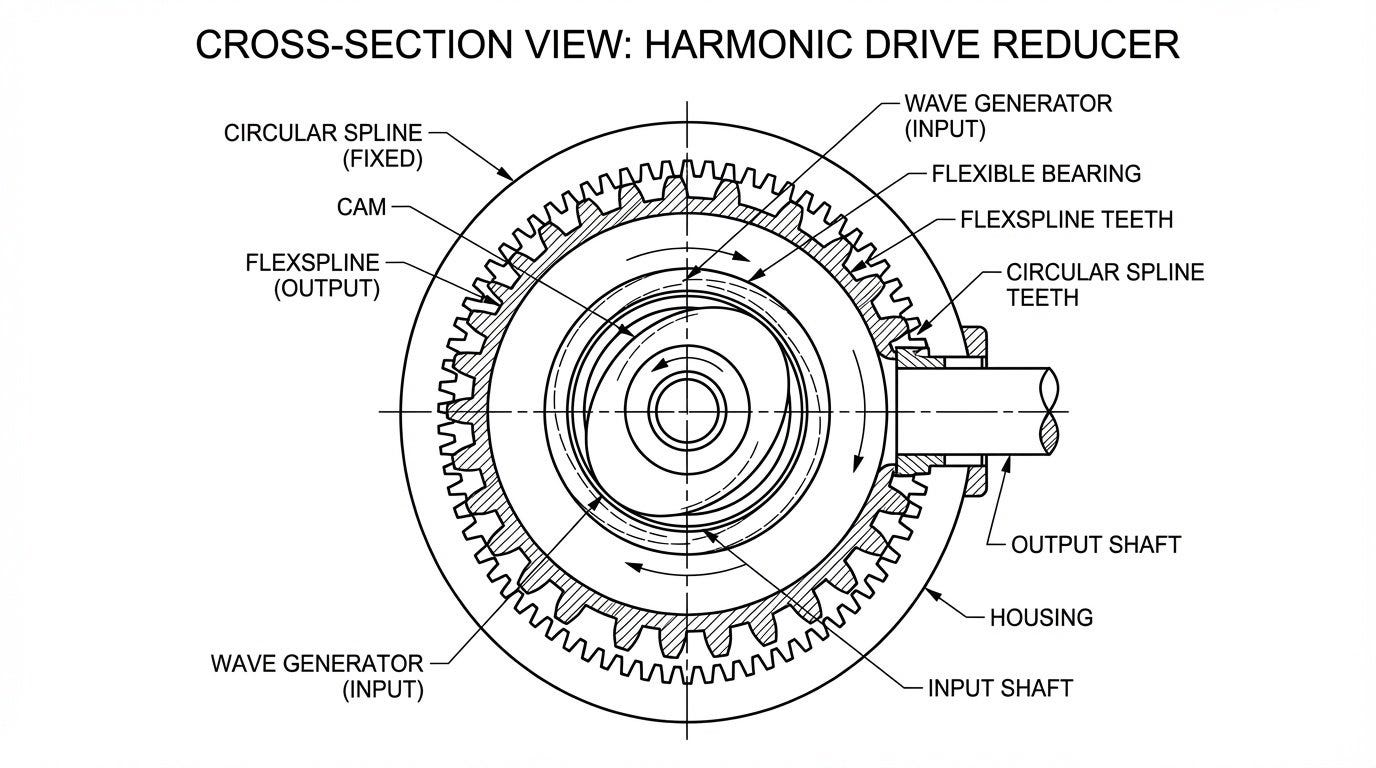
From a manufacturing perspective, the critical technology centers on the flexspline material and heat treatment processes. The flexspline must withstand repeated elastic deformation cycles, demanding exceptional fatigue resistance. However, the overall machining tolerance requirements remain relatively moderate. The limited number of primary components and straightforward assembly procedures created feasible entry points for domestic manufacturers to achieve technical breakthroughs.
RV Reducers: Compound Precision in Multi-Stage Transmission
RV reducers employ a compound transmission system combining involute planetary gears with cycloidal pinwheel mechanisms. The first stage utilizes involute planetary gear reduction, followed by a second-stage cycloidal pin-wheel reduction. This architecture enables RV reducers to handle substantial radial loads and impact forces, making them particularly suitable for the first three joints of industrial robots where torque requirements peak.
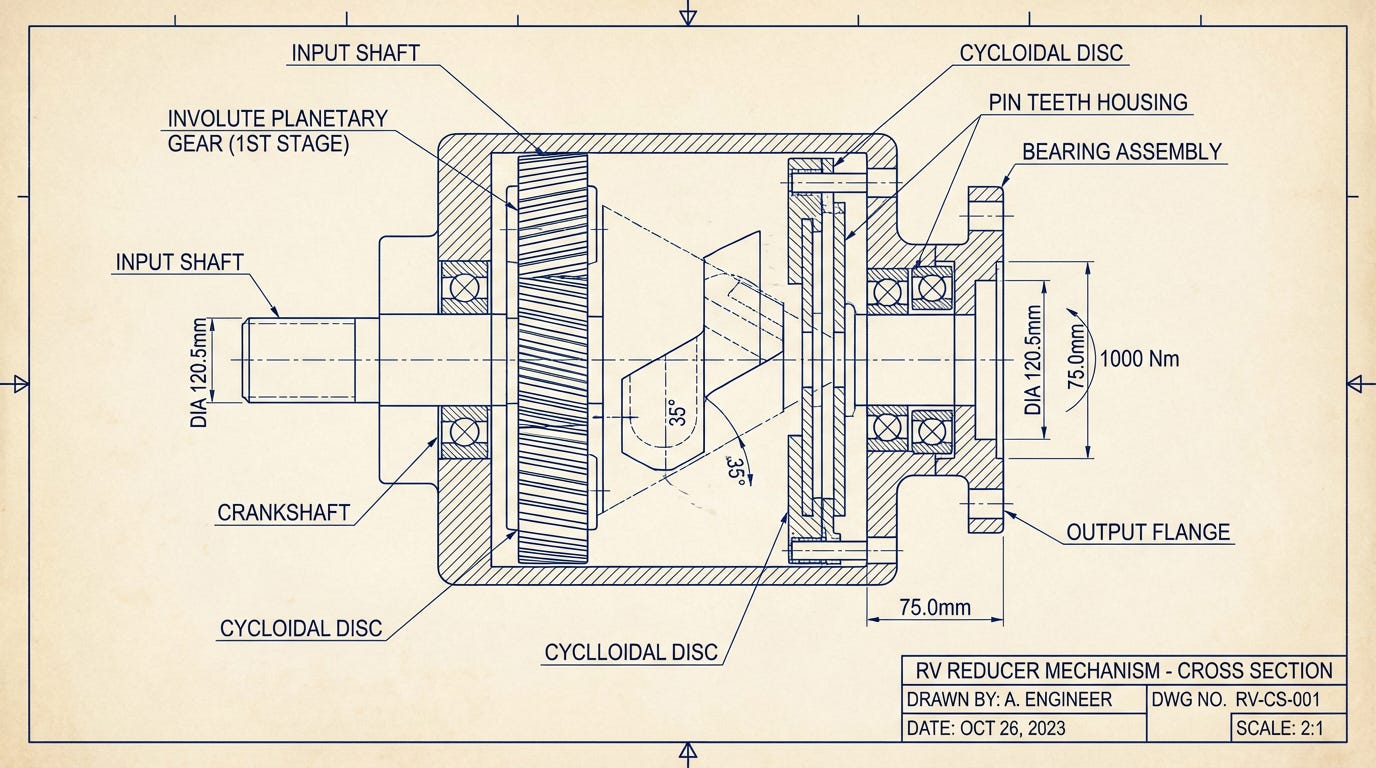
This sophisticated structure introduces formidable manufacturing challenges. A complete RV reducer contains 20-30 precision components, including involute gears, cycloidal discs, pin housings, crankshafts, and multiple bearing assemblies. Each component requires micron-level machining precision, where deviations in any single element cascade into overall performance degradation.
The Manufacturing Precision Chasm
Exponential Difficulty in Tolerance Requirements
Precision advancement in mechanical engineering does not follow linear progression—each incremental improvement in tolerance demands exponential increases in manufacturing capability.
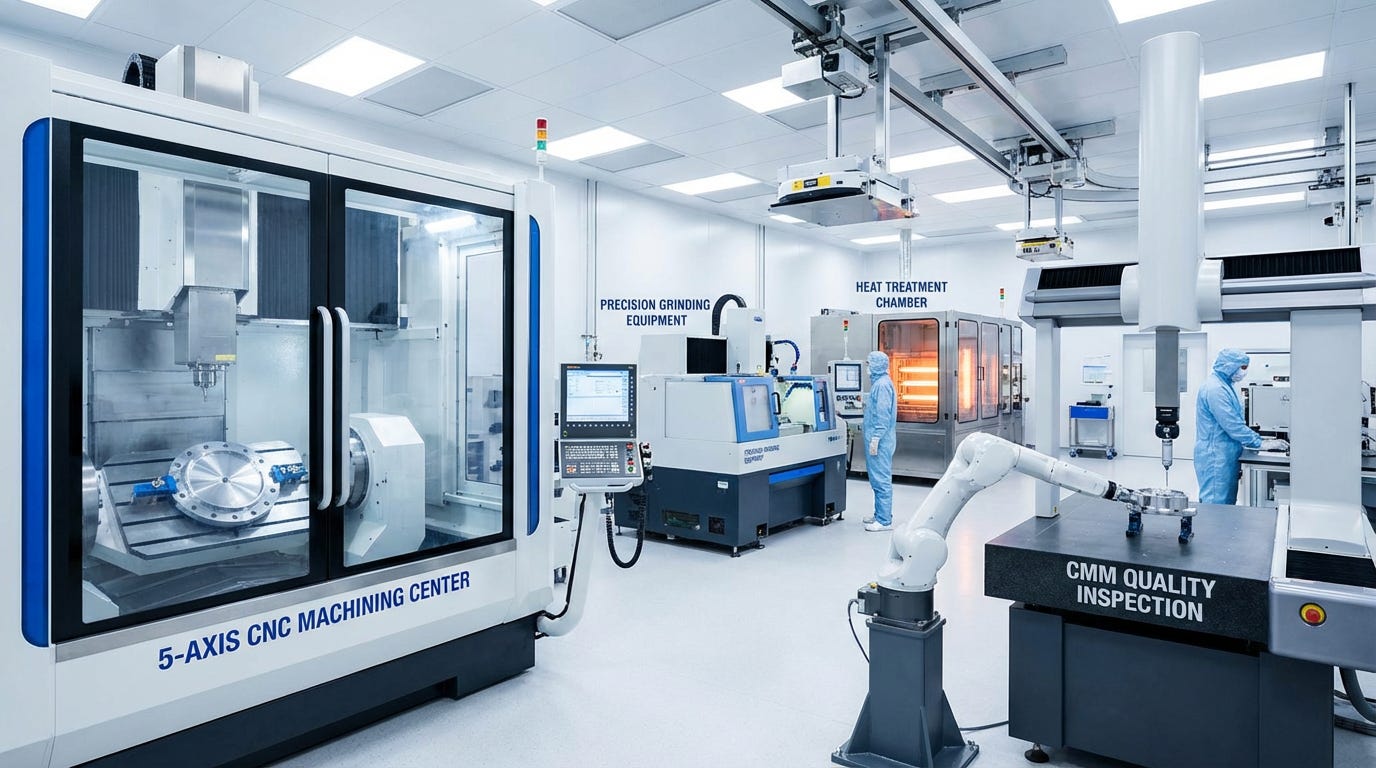
Harmonic drive flexspline tooth profile tolerances typically range within ±0.01mm, achievable with modern CNC equipment. In contrast, RV reducer cycloidal disc tooth profiles demand tolerances within ±0.001mm, with premium variants requiring ±0.0005mm precision. This order-of-magnitude difference necessitates step-changes in machining equipment, metrology systems, and environmental controls.
The cycloidal disc machining process requires specialized cycloidal grinding machines or wire EDM equipment, followed by multiple heat treatment cycles and precision grinding operations. Throughout this process, minute variations in temperature, tool wear, or vibration interference result in precision failure. Domestic manufacturers face significant gaps compared to Japanese manufacturers like Nabtesco in equipment stability and process control mastery.
The Hidden Barrier of Material Science
Material science represents an easily overlooked yet critical gap. RV reducer cycloidal discs and pin teeth require specialty alloy steels, typically 40CrNiMoA or equivalent grades. These materials demand exceptional purity and microstructural homogeneity, imposing stringent requirements on metallurgical processes.
While domestic steel mills produce nominally equivalent grades, microscopic indicators including impurity control, grain refinement, and structural uniformity reveal persistent gaps. These material performance differences manifest in reduced fatigue life and impact resistance. Material property advancement requires decades of process refinement and quality management experience—knowledge accumulated through sustained industrial practice rather than rapid technology transfer.
The Craftsmanship in Assembly
RV reducer assembly transcends simple component integration—it demands experiential knowledge and technical finesse. Critical parameters including cycloidal-to-pin mesh clearance, crankshaft eccentricity, and bearing preload require precise adjustment during assembly.
Experienced assembly technicians develop tactile and auditory sensitivities to evaluate transmission pair mesh conditions. This “tacit knowledge” resists complete codification into standardized procedures. Japanese manufacturers have cultivated mature training systems and quality cultures over decades. Domestic enterprises require time to develop equivalent talent pipelines and knowledge transfer mechanisms.
The Localization Journey
Harmonic Drives: The Successful Breakthrough
Chinese manufacturers, exemplified by companies like Leader Harmonics, have achieved remarkable progress in harmonic drive technology. Through strategic equipment acquisition, technology absorption, and indigenous innovation, domestic products now approach the performance of established suppliers like Harmonic Drive Systems.
2025 market data indicates Leader Harmonics commands 12% global market share in harmonic reducers, ranking second domestically behind Harmonic Drive Systems. Crucially, domestic products have achieved large-scale deployment in Chinese-manufactured robots, enabling import substitution. Certain product specifications exceed international competitor performance.
This breakthrough stemmed from concentrated technical challenges. Harmonic drive core technology focuses primarily on flexspline materials and processing. Success in these areas enables competitive products. Additionally, relatively fixed application scenarios—predominantly robot terminal joints with moderate load requirements—simplified development targets.
RV Reducers: The Persistent Challenge
RV reducer localization faces substantially greater difficulty. While domestic manufacturers including Nantong Zhenkang and Shuanghuan Driveline have introduced RV products, they cannot yet challenge Nabtesco’s dominance in premium segments.
Industry statistics show Nabtesco maintains over 53% global RV reducer market share, reaching 60% in China. Leading international robot manufacturers including ABB, FANUC, and Yaskawa predominantly specify Nabtesco RV reducers. This market structure proves difficult to disrupt near-term.
The fundamental issue: RV reducer technical barriers operate systemically. Success demands not only individual component precision but integrated precision matching and long-term reliability validation. Qualified RV reducer products require minimum 2-3 years of field operation testing to verify lifespan and stability claims.
Intellectual Property Barriers and Technology Encirclement
Japanese manufacturers have constructed comprehensive patent portfolios around RV reducer technology. Nabtesco holds extensive patents covering core structures, manufacturing processes, and testing methodologies. Domestic manufacturers face infringement risks even when developing functionally similar products.
This environment compels domestic manufacturers toward indigenous innovation pathways, necessitating structural optimization and process modifications that circumvent existing patents. However, this approach demands substantial R&D investment and time accumulation, with limited short-term returns.
Root Causes of the Technology Gap
Generational Industrial Foundation Differences
Japanese precision manufacturing capabilities trace back to the 1950s. From watches and cameras to machine tools and robots, Japanese enterprises developed comprehensive supply chains and talent pipelines in precision mechanics. Nabtesco’s predecessor, Teijin Seiki, initiated RV reducer development in 1986, accumulating nearly 40 years of technical depth.
In contrast, China’s industrial robot industry emerged in the early 2000s, with precision reducer R&D lagging 20-30 years behind. This generational gap cannot be rapidly bridged through technology transfer or capital injection alone.
Quality Culture Distinctions
Japan’s renowned “craftsmanship spirit” manifests concretely in quality consciousness permeating every production stage. From raw material incoming inspection through final product testing, rigorous standards and continuous improvement mechanisms operate systematically.
During rapid expansion, Chinese enterprises often prioritized capacity scaling and market share over lean manufacturing and quality culture development. This results in product consistency variations and long-term reliability fluctuations.
Application Validation Feedback Loop Deficits
RV reducer performance validation requires extended field operation under real working conditions. Foreign manufacturers maintain close collaborative relationships with robot OEMs, enabling rapid application feedback and continuous product optimization.
Domestic manufacturers face a chicken-and-egg dilemma: robot manufacturers hesitate to adopt domestic reducers due to reliability concerns, while reducer manufacturers lack application scenarios to validate and refine products. Breaking this cycle requires patience and coordination across the industrial value chain.
Potential Breakthrough Pathways
Technical Innovation and Differentiation Strategies
Rather than purely chasing existing Japanese products, domestic enterprises should explore new technologies and structural configurations. Opportunities include advanced materials, optimized cycloidal tooth profiles, and intelligent monitoring systems to establish differentiated advantages in specific segments.
Recent initiatives include two-stage RV reducer development and cycloidal-gear compound transmissions designed to circumvent traditional RV reducer patents. While these explorations remain nascent, they represent encouraging directions worthy of support.
Deep Industry-Academia-Research Integration
Reducer technology breakthroughs require multidisciplinary collaboration spanning materials science, mechanical design, and manufacturing processes. Chinese universities and research institutions possess strengths in fundamental research, but connections with industry remain insufficient.
Establishing enterprise-led, market-oriented industry-academia-research mechanisms can accelerate research commercialization. Enterprises must invest in fundamental research rather than focusing exclusively on immediate returns.
Policy Support and Patient Capital
RV reducer R&D represents a long-cycle, high-investment, slow-return process. Enterprises require sustained policy support including R&D subsidies, tax incentives, and first-adoption incentive programs.
Patient capital proves equally crucial. Impatient capital demanding rapid profitability contradicts the long-term nature of technology development. National industrial funds and strategic investors should provide enterprises with adequate tolerance for setbacks and development timelines.
End-User Inclusion and Support
Domestic robot manufacturers should prioritize domestic reducer brands in component selection. Adopting a “domestic priority, progressive substitution” strategy—validating domestic reducers in lower-tier applications before advancing to premium segments—can establish necessary track records.
Simultaneously, comprehensive quality traceability and technical support systems enable downstream customers to confidently adopt domestic products. Only through application integration can virtuous industrial cycles emerge.
Conclusion
The success of domestic harmonic drive reducers demonstrates that technical gaps can narrow with correct strategy and sustained investment. RV reducer challenges prove more formidable, but not insurmountable.
This journey requires not only technical breakthroughs but industrial chain coordination, quality culture cultivation, and talent pipeline development. The path forward demands clear recognition: this is not a sprint but a marathon.
The outlook for domestic RV reducers warrants cautious optimism. Technological progress never follows linear trajectories, yet persistent effort inevitably yields results. The aspiration remains that in the near future, Chinese-manufactured robots will integrate fully domesticated “joints,” demonstrating genuine competitiveness in global markets.
References
Industrial Robot Reducer Industry Research Report (2025)
National Robotics Industry Development Plan
Frontier Research in Precision Transmission Technology
Public technical documentation from major reducer manufacturers
🎯 Master Robotics Engineering (The Way School Never Taught)
After 13 years in the field, I’ve learned that the best engineering knowledge doesn’t come from textbooks—it comes from real projects, failures, and breakthroughs.
That’s what I share every week in The Robotics Engineer’s Digest:
Technical Deep Dives → Real engineering analysis with formulas
Case Study Breakdowns → Learn from $100K+ mistakes (so you don’t repeat them)
Component Selection Guides → Decision frameworks for motors, reducers, sensors
Industry Intelligence → What’s actually happening in humanoid robotics, automation, AI
100% free. Zero spam. Unsubscribe anytime.
💬 What Are You Working On Right Now?
I create content based on what engineers actually need.
Comment below and tell me:
What type of robot/automation project are you working on?
What’s your biggest technical challenge right now?
What topic would you like me to cover next?
100+ engineers have already shared. Your input shapes future articles!
Join 100+ robotics engineers getting smarter every week: